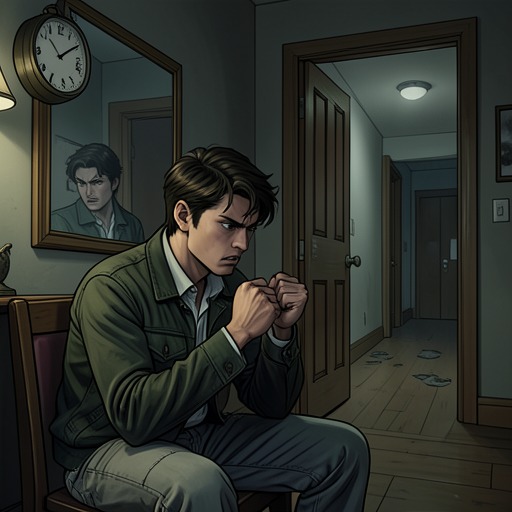
Domestic violence in the Jeon family
𝐋𝐚𝐜𝐮𝐧𝐚 | 𝑱𝒆𝒐𝒏 𝑱𝒖𝒏𝒈𝒌𝒐𝒐𝒌Domestic violence in the Jeon family is a recurring pattern of coercion and physical abuse, not a single outburst. Dong-hyun’s attacks on Min-ha and Jungkook make the home a place of fear, while Jungkook’s attempts to resist or protect his mother expose him to further punishment. The abuse becomes a lasting source of his anger and distress, and helps explain why violence and affection remain entangled in his later relationships.
Background and Pattern
Jungkook later describes a childhood in which he knew violence rather than dependable parental affection. His father drank heavily and assaulted Min-ha, sometimes leaving her unconscious; Jungkook recalls that the only tenderness he received came from his mother when she was not incapacitated by Dong-hyun’s beatings. Jungkook and his older brother, Ye-jun, were frightened of their father, but fear did not keep Jungkook from trying to intervene.
During one confrontation in the family home in Gangnam, Seoul, Ye-jun held eight-year-old Jungkook back because he feared his younger brother would put himself in danger by going downstairs. As the argument between their parents grew louder, Jungkook broke free and went toward the kitchen. Dong-hyun ordered him back to his room; Jungkook refused and demanded that his father leave Min-ha alone. Dong-hyun laughed, finished his drink, and hurled the glass against a wall. A shard struck Jungkook’s face, and Dong-hyun seized him by the shirt and slapped him repeatedly. Jungkook was left with fear and rage at once, an early instance of the emotional confusion that the household’s violence repeatedly produces.
Escalation and Household Control
The pattern is sustained not only through physical assaults but also through the way Dong-hyun controls what may be said, who may intervene, and when Jungkook is allowed to appear. On one occasion, Min-ha comforts her youngest son as he cries, telling him she believes he is capable of great things. Her reassurance is interrupted when Dong-hyun and Ye-jun enter. Dong-hyun demands to know why Jungkook is crying; when the boy says nothing is wrong, his father grabs him by the collar. The moment turns comfort into danger: Min-ha’s tenderness is real, but it offers no lasting protection from the violence that follows her husband into the room.
Dong-hyun’s contempt also polices Jungkook’s expression of fear and vulnerability. He mocks the child for crying and tells him to imitate Ye-jun, using a slur to frame softness as shameful. After leaving the room, he leaves behind the familiar silence of the household. Ye-jun approaches to embrace his younger brother, but Jungkook shoves him to the floor and tells him not to come near him again. The violence therefore reaches beyond the father’s blows: it damages the brothers’ attempts at comfort, turning an offered embrace into another point of rupture.
A later episode shows how quickly Dong-hyun’s authority can shift from public composure to private brutality. While a guest, Mr. Hamilton, is visiting, Dong-hyun calls Jungkook upstairs, grips him by the throat, and pins him against the wall. He orders the child to remain in his room until the guest has left. After dinner, Dong-hyun goes back upstairs despite Min-ha’s attempt to stop him. He slaps Jungkook, removes his belt, tears open the boy’s shirt, and beats his bare back. Jungkook cannot move or bring himself to scream; Min-ha repeatedly tries to intervene, while Ye-jun shuts himself in his own room and covers his ears. When the beating ends, Dong-hyun threatens Min-ha for trying to protect their son, then leaves her to find Jungkook unable to stand, his back bleeding. She helps him as he silently allows her to care for him, while Ye-jun enters and Jungkook turns his face away. The scene makes the household’s pattern unmistakable: resistance is punished, protection is suppressed, and the aftermath is borne in silence.
Flight, Refuge, and the Inheritance of Fear
The abuse did not end when an individual beating stopped; it shaped what Jungkook could tell others and where he could feel safe. Sunmi first knew him as a quiet child, then saw him return with a badly injured face. He said he had been in a school fight and that Namjoon had helped him, concealing that his father had beaten him. Sunmi believed him at the time. At sixteen, Jungkook fled his home and sought refuge with her; Dong-hyun did not look for him. Sunmi welcomed him without hesitation, and Jungkook remained grateful for the shelter she gave him. His flight marks a change in immediate circumstance, not an erasure of what he had endured: Sunmi worried about the darkness around him and about his turn toward things a sixteen-year-old should not have touched.
Jungkook’s later account to Shelby makes explicit how thoroughly violence had defined his early understanding of family and intimacy. He describes Dong-hyun as a poor model both as a father and in sentimental matters: what he knew was violence, while the small measure of love he received came from Min-ha when she was not unconscious from her husband’s blows. He and Ye-jun had feared their father, yet Jungkook had repeatedly tried to stand up to him. The account links his adult difficulty with closeness to a childhood in which protection and affection were fragile, and fear was inseparable from the people he wanted to defend.
That history does not make Jungkook’s later choices harmless, but it gives their recurrence context. After he and Shelby kiss, he acknowledges that he lost control, bought and used cocaine, and treated her cruelly; in explaining himself, he returns to the violence and neglect he knew at home. Later, when he speaks of returning to the Ares Garden ring, he describes being drawn into a trance by the vice and says fighting brought relief, before the sight of Shelby’s tear-streaked face made him regret what he had done. The pattern is not presented as a simple repetition of his father’s conduct: Jungkook can name the damage, recognize the harm to Shelby, and speak about his past. But his disclosures also show how the household’s violence persists as a force in his adult life, entangled with anger, self-destructive impulses, and his effort to learn a different form of intimacy.
The Afterlife of Violence and a Counterpattern of Care
The household’s violence remains present in Jungkook’s adult life not only as a memory but as a pressure that can pull him toward self-destruction. When he explains his cruelty to Shelby after their kisses, he connects his loss of control and cocaine use to the example set by his father, whose drinking and violence had shaped his childhood. Later, he describes returning to the Ares Garden ring as feeling like a trance: fighting briefly brought relief, but seeing Shelby’s tear-streaked face made him regret going back. The connection gives his behavior a history without excusing the harm he causes. His account recognizes both the force of the old pattern and the responsibility to confront what it does to someone else.
His responses to Shelby’s distress offer a contrast to the coercion he grew up with. In the university locker room, he finds her trembling and crying beneath the running shower, turns off the water, crouches beside her, and stays without knowing what to say or trying to force an explanation. When she calms, he remains present rather than demanding that she accept comfort. On another occasion, after she breaks down in pain and begins to cry, he approaches, crouches, and rests a hand on her knees; she is seeking reassurance, and the contact becomes a source of comfort rather than a threat.
That distinction is especially visible during Shelby’s panic in a restroom. When Madison realizes that Shelby fears being touched and goes to find Jungkook, he runs to her. Shelby recognizes him, wraps her arms around his neck, and presses her face to his shoulder; he strokes her back and speaks softly until her breathing returns to normal. The scene does not erase Jungkook’s inherited history of violence. Instead, it shows a different response to fear taking shape through attention to Shelby’s cues and the comfort she actively accepts—a fragile counterpattern to the control, punishment, and silencing that defined his childhood home.